

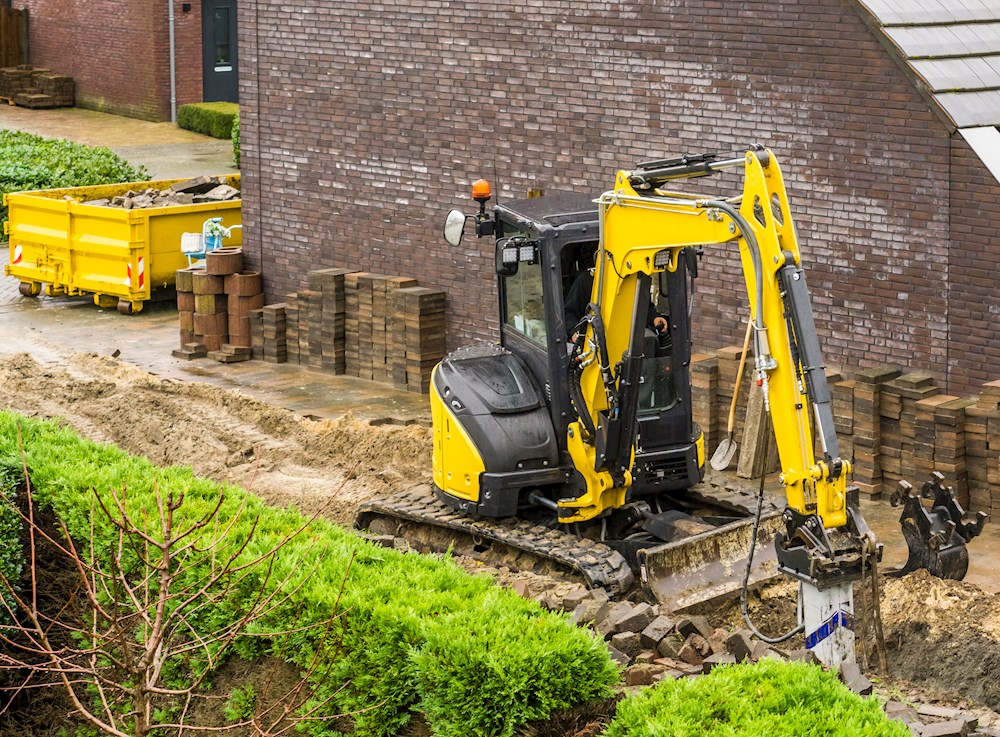
Costs of clearing the garden
Clearing a garden costs on average between €800 and €1,300, depending on the size and complexity of the work. This task involves removing all elements such as plants, paving, trees, ponds, and other materials to create a clean base for a new garden design. In this price guide, you can read about the costs of clearing a garden and what to look out for during execution.
Table of Contents
What is the cost of clearing a garden?
Clearing a garden costs on average between €800 and €1,300 for a complete project. These costs are determined by factors such as the size of your garden, the type of materials that need to be removed, and the complexity of the work. Gardeners use different rate structures: an hourly rate from €50, a rate per m² of €15, or a project price agreed in advance.
Cost overview per component
Component | Unit | Average costs |
|---|---|---|
Gardener hourly rate | per hour | from €50 |
Professional via Zoofy | per m² | €15 |
Removing paving | per hour | €40 |
Removing tree stump by digging | per project | €50 - €200 |
Removing tree stump with stump grinder | per project | €50 - €100 |
Removing large tree stump (>80cm diameter) | per project | €300 - €500 |
Felling a tree | per project | €400 - €800 |
Removing a pond | per hour | €50 |
Raising or excavating garden | per m² | €15 |
The table shows how the costs for clearing a garden are built up per component. For simple tasks such as removing grass and plants, a price per m² is often charged, while more complex jobs with unpredictable time investments like removing ponds or felling trees are more likely to be on an hourly basis or a project price. Note that removing large tree stumps costs significantly more than smaller ones.
The prices mentioned include 21% VAT and labour. These are indicative prices based on previously completed jobs by the affiliated professionals.
Cost of garden clearing per type of garden
The costs for clearing a garden vary greatly by type. A simple garden with only a lawn costs less than a complex garden with paving, ponds, and trees. For a standard garden of 60 m², costs range between €500 and €1,200, depending on the complexity.
Garden type | Features | Indicative costs |
|---|---|---|
Simple garden | Lawn, small shrubs, no paving | €500 |
Average garden | Lawn, decking/terrace, paving | €800 |
Complex garden | Lawn, paving, pond and/or trees | €1,200 |
Tree size | Specifications | Costs |
|---|---|---|
Small tree | height up to 6m, trunk circumference up to 20cm | €400 |
Average tree | height 6-8m, trunk circumference up to 35cm | €600 |
Large tree | height from 8m, trunk circumference from 35cm | €500 |
Price-determining factors for clearing a garden
The costs for clearing a garden are determined by various factors that influence labour time, material use, and complexity.
Complexity and garden elements
A garden with only a lawn can be cleared quickly by ploughing the grass. If you add paving, ponds, or large trees, the labour duration increases significantly. Paving must be broken up, cleared, and disposed of. Pumping out a pond, removing the liner, and filling the hole takes several hours of work.
Accessibility of the garden
With good accessibility, an excavator can enter the garden directly, significantly speeding up the work. With poor access, such as a narrow gate or access only through the house, everything must be done manually. This costs more time and effort.
Size of the garden
A larger garden means more square metres to be cleared, which increases the total price. At the same time, for larger gardens, the price per m² may be lower because machines can be used more efficiently.
Excavation depth
For terraces, a minimum depth of 20 cm must be excavated to create a stable substrate. For driveways, 40 cm depth is required. When removing trees, it is sometimes necessary to dig up to 75 cm deep to remove all roots. Deeper digging costs more time, which directly affects the price.
Required materials and machines
Special equipment is needed for large trees or deep ponds, such as a stump grinder, an excavator, or an aerial platform. The rental and use of these machines increase the total costs.
Disposal costs
Disposing of garden waste accounts for approximately 20 to 25% of the total project costs. Labour takes up about 50%, materials and machines 15%, and preparation 10%.
Region
Prices are often higher in large cities due to higher hourly rates and disposal fees. Costs can therefore vary by region.
Urgency and planning
Planned work is more cost-effective than urgent jobs. Weekend work also incurs surcharges. For the best rates, plan your job on a weekday in advance.
Preparation
Ensure the workspace is clear. Move garden furniture and pots to the shed. Make a list of what should stay and what can go. This saves the professional time and prevents misunderstandings.
Local professional
Local professionals can arrive faster. At Zoofy, you do not pay call-out charges, which has a positive impact on the total price.
Extra costs and surcharges
Extra costs depend on the specific situation, but at Zoofy, you do not pay call-out charges. Extra costs may arise from:
Surcharges for urgent jobs or weekend work
Removing large tree stumps (diameter > 80 cm) costs €300 to €500 per stump
Use of special equipment like an excavator or aerial platform
A KLIC notification is mandatory for mechanical digging to avoid damaging underground cables
How does the gardener work when clearing a garden?
Clearing your garden follows a systematic process:
Planning and preparation: The gardener determines with you which parts will be cleared.
Equipment: The professional arranges the right tools, from excavators to stump grinders.
Removing large elements: Starting with felling trees, pumping out ponds, and breaking up paving.
Removing smaller elements: Removing plants, shrubs, hedges, and turf.
Excavating: Digging to the required depth (20 cm for terraces, 40 cm for driveways, 75 cm for roots).
Levelling: If necessary, the garden is raised with new sand or levelled (€15 per m²).
Waste disposal: All waste is loaded into containers and taken to the landfill. A simple garden is often finished in one day; complex ones take two to three days.
How can you save on clearing your garden?
Dispose of waste yourself: This can save 20 to 25% of the costs if you have the time and means to transport it.
Perform preparatory work: Clear furniture and pots yourself to save the professional's time.
Plan on weekdays: Avoid surcharges for weekend or urgent bookings.
Keep what is good: If parts of the garden are still in good condition, incorporate them into the new design.
Book via Zoofy: Benefit from a fixed rate without call-out charges.
Common problems with insufficient excavation
Subsiding paving
If the soil is not excavated deeply enough, tiles and clinkers can subside over time, leading to an uneven terrace that requires expensive repairs.
Drainage issues
Insufficient excavation leads to poor drainage, causing puddles to remain after rain due to compacted soil.
Remaining roots
Roots that are not fully removed can damage utility lines or new paving, and weeds may quickly return.
Find the best gardener for clearing your garden
A professional gardener has the equipment and experience to clear your garden efficiently. At Zoofy, you are matched with local professionals, meaning no call-out charges and a fixed price in advance. You pay easily via QR code only after the job is completed to your satisfaction.
Frequently asked questions about garden clearing
How much does it cost on average to clear a garden?
The average cost is between €800 and €1,300. A simple garden of 60 m² costs about €500.
How long does it take?
A simple garden usually takes one day, while more complex gardens take two to three days.
Is a permit required?
Usually not for clearing, but a felling permit may be required for certain trees depending on local regulations.
What is a KLIC notification?
It is a mandatory notification for mechanical digging to prevent damage to underground cables and pipes.