
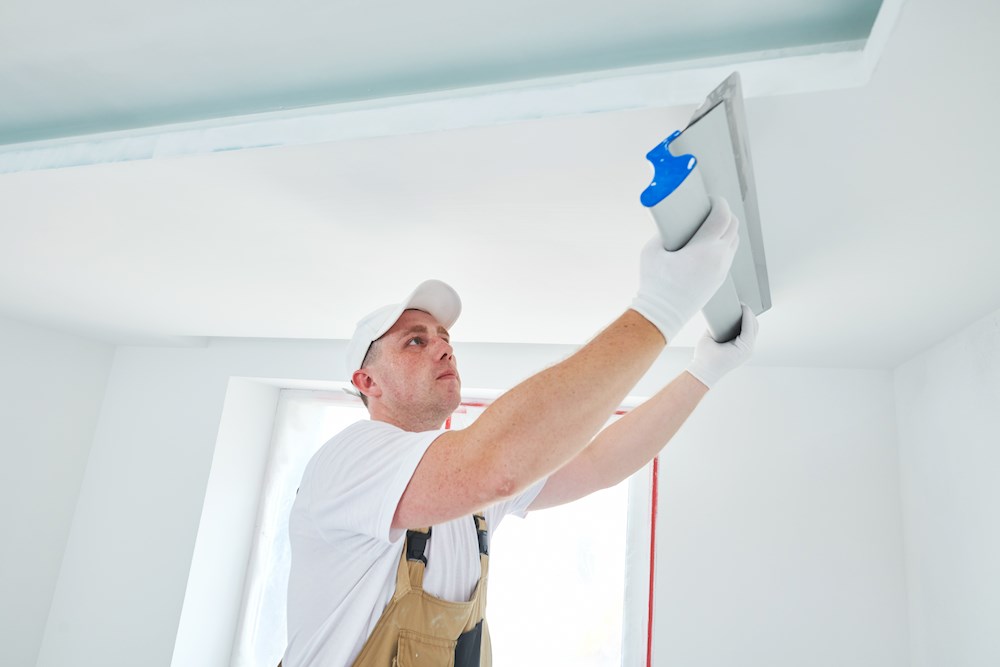
Finishing a ceiling costs on average between €7 and €95 per square metre, depending on the chosen method. A professional can finish your ceiling with plasterwork, stretch ceilings, or suspended ceilings to create a smooth, finished surface. The costs for finishing a ceiling are mainly determined by the type of finish and the surface area. In this price guide, you can read about what different finishing methods cost and what to look out for when making your choice.
What does finishing a ceiling cost?
Finishing a ceiling costs on average between €7 and €95 per square metre, including labour and VAT. The exact price depends on the finishing method you choose: spray plastering is the most economical, while a stretch ceiling is the most expensive.
Costs of ceiling finishing per type
Finishing method | Price per m² |
|---|---|
Spray plastering (Spack) | €7-10 |
Wallpaper-ready plastering | €10-20 |
Paint-ready plastering | €15-30 |
Decorative plaster | €20-25 |
Suspended ceiling | €45-60 |
Gyprock ceiling | €55-70 |
Stretch ceiling | €70-95 |
The table shows the costs for finishing a ceiling for various methods, ranging from cheap to expensive. Spray plastering is the most affordable option for a simple finish, while a stretch ceiling requires the highest investment. The middle category, such as plastering and decorative plaster, offers a balance between price and finish quality.
All prices include 21% VAT and labour. The costs are calculated per square metre, allowing you to estimate your total investment well in advance based on your ceiling surface area.
Costs of ceiling finishing per type
The costs for finishing a ceiling vary greatly per finishing method. Spray plastering is the cheapest option at €7 per square metre, while a stretch ceiling requires the highest investment at €95 per square metre. Below you can see what different finishing methods cost and what features they offer.
Finishing method | Price per m² | Key features |
|---|---|---|
Spray plastering (Spack) | €7-10 | Fast finish, suitable for subsequent painting |
Wallpaper-ready plastering | €10-20 | Smooth surface, ready for wallpapering |
Paint-ready plastering | €15-30 | Extra smooth, ready for painting |
Decorative plaster | €20-25 | Decorative texture, no painting required |
Suspended ceiling | €45-60 | Ideal for hiding pipes, replaceable parts |
Gyprock ceiling | €55-70 | Impact-resistant and fire-retardant, good sound insulation |
Stretch ceiling | €70-95 | Many colour and material options, water protection, good insulation |
Price-determining factors for ceiling finishing
The costs for finishing a ceiling are determined by several factors. Below you can read exactly what influences the price and what you can watch out for to control costs.
Surface area of the ceiling
The total surface area largely determines your investment. A larger ceiling costs more in total, but the price per square metre can decrease for larger areas because the professional can work more efficiently and fixed preparation costs are spread over more square metres.
Height of the ceiling
Higher ceilings require extra equipment such as scaffolding or telescopic work arms. This increases labour costs because the work takes more time and requires extra material to work safely.
Condition of the current ceiling
A ceiling with cracks, moisture damage, or peeling old finish requires extra preparation time. The professional must first repair, sand, or remove old layers before the new finish can be applied.
Materials required
Material costs vary greatly per finishing method. Spray plastering uses affordable materials, while a stretch ceiling requires specific foils and rail systems that are more expensive.
Complexity of the job
Integration of recessed spotlights, ventilation openings, or acoustic panels makes the job more complex. This requires more craftsmanship and time, increasing labour costs.
Accessibility of the room
Hard-to-reach ceilings, such as in attics with narrow staircases or in rooms full of furniture, take extra time. The professional must make more effort to get material and tools on site.
Region
In large cities, costs are often higher than in rural areas due to higher labour costs and travel distances.
Urgency versus planned work
Urgent jobs cost more than planned work. In case of urgency, the professional must adjust his schedule, which involves extra costs.
Weekend or weekdays
Work at the weekend is more expensive than during the week. Preferably plan your job on a weekday to save costs.
Preparation by the customer
If you move furniture and remove old decorations yourself, this saves labour time. A clear and easily accessible workplace lowers the total price.
Timely maintenance
Addressing small cracks or imperfections early prevents bigger problems. An outdated ceiling with many defects costs more to repair than a ceiling that has been regularly maintained.
Choice of local professional
Local professionals can be on-site faster and have lower travel costs, which favourably influences your total price.
Transparent prices
At Zoofy, you know what you pay in advance, without call-out charges or surprises afterwards. This helps you plan costs better.
Additional costs and surcharges
Extra costs when finishing a ceiling are situation-dependent. At Zoofy, you do not pay call-out charges.
Urgency surcharge: For urgent jobs, a surcharge applies because the professional must adjust his schedule
Weekend surcharge: Work at the weekend is more expensive than during the week
Preparation work: If the existing ceiling must first be repaired, levelled, or stripped of old finish, this increases the total price
Lighting integration: Installing spotlights, LED lighting, or other recessed spots is additional work that is charged separately
Ventilation and acoustics: Integrating ventilation openings or acoustic panels increases the total price
Asbestos remediation: If the old ceiling contains asbestos, it must first be professionally remediated before finishing can take place
How does the professional work when finishing a ceiling?
Finishing a ceiling follows a fixed sequence of preparing, applying, and checking.
Preparation: The professional inspects the existing ceiling for cracks, imperfections, and moisture damage. If necessary, repairs are carried out and loose pieces are removed. In the case of a lowered ceiling, the construction is measured and the framework prepared.
Execution: Depending on the chosen method, the professional applies the plasterwork in one or more layers, mounts the profile for a stretch ceiling and stretches the fabric into it, or installs the plasterboards or suspended ceiling tiles. For plasterwork, sanding is done between layers for a smooth result.
Finishing and check: After application, the professional checks the finish for imperfections. For plasterwork, a final sanding session may follow. The space is tidied up and you receive an explanation about drying times and use.
Lead time: Plasterwork requires several days due to drying times between layers, after which the ceiling can be painted or wallpapered after 24 to 48 hours. A stretch ceiling is ready in a few hours and immediately usable. Installing a gyprock ceiling or suspended ceiling takes an average of 1 to 2 days.
Your preparation: Ensure the room is clear and accessible. Move furniture to another room or cover it up. Remove loose decorations from the ceiling yourself to limit costs.
How can you save on ceiling finishing?
There are several ways to reduce the costs of finishing a ceiling without compromising on quality.
Tackle problems early: Repairing small cracks or loose pieces in time prevents larger damage that is more expensive to repair later.
Prepare the workspace yourself: Move furniture, clear the space, and remove old decorations. This saves labour hours and lowers the total price.
Plan during the week: Don't book the job during the weekend or with urgency. Work scheduled during the week is more economical.
Combine multiple ceilings: Have several ceilings finished at the same time. The professional is already there and you benefit from economies of scale.
Choose the right method: Determine if you really need a lowered ceiling. Plasterwork is considerably cheaper than a stretch or gyprock ceiling and often suffices perfectly.
Book via Zoofy: You get a fixed rate in advance, without call-out charges and without surprises. You only pay after completion of the task.
Common problems with ceiling finishing
Problems with a ceiling can have various causes and require timely attention.
Cracks in the ceiling
Cracks occur due to settling of the house, temperature fluctuations, or a poorly applied previous finish. If you ignore them, they get bigger and repair is more expensive later.
Moisture damage
Leaks or condensation cause stains, peeling paint, or mould. The moisture source must first be resolved before the ceiling can be finished, otherwise the problem will return.
Uneven substrate
Older ceilings are often uneven, which requires extra levelling work before the finish can be applied.
Peeling old finish
Old paint, plaster, or wallpaper that is peeling must be completely removed. This guarantees good adhesion of the new finish.
Asbestos ceilings
In homes from before 1994, ceilings may contain asbestos. This must be professionally remediated before further work takes place.
Find the best professional for ceiling finishing
A reliable professional with the right specialisation ensures a professionally finished ceiling.
No call-out charges: You never pay extra for the professional's arrival, keeping the costs clear.
Fixed price in advance: You know exactly what you pay, without surprises afterwards.
Book quickly without quote hassle: Choose a time and book directly, without comparing multiple quotes first.
Payment via QR code after completion: You only pay once the job has been completed to your satisfaction.
Reliable, screened professionals: All affiliated professionals are thoroughly screened before they can carry out jobs.
Specialisation is important: Not every plasterer has experience with stretch ceilings or suspended ceilings. Choose a professional with experience in the specific finishing method you need.
Ask for references: A good professional can show references from similar jobs and gives clear explanations about their working method and experience.
Book a professional for ceiling finishing
Ready to have your ceiling finished? At Zoofy, you book a professional directly, without quotes and without call-out charges. You see exactly what it costs in advance, and Zoofy pairs you with a reliable professional who has been screened. You only pay once the work is done. Book a professional directly now.
Useful links
Frequently asked questions
For 50 square metres of plasterwork, you pay between €350 and €1,500, depending on the finishing method. Spray plastering costs approximately €350 to €500, while paint-ready plastering lies between €750 and €1,500. The costs per square metre often decrease for larger surface areas.
Spray plastering is the cheapest option with prices starting from €7 per square metre. This method provides a fast, simple finish that you can then paint. For a higher budget, paint-ready plastering or decorative plaster offer a smoother and more durable result.
A stretch ceiling is installed within a few hours and directly usable. Plasterwork requires several days due to drying times between layers, usually 24 to 48 hours per layer. Installing a gyprock ceiling or suspended ceiling takes an average of 1 to 2 days.
That depends on the state of the existing ceiling. In case of peeling finish, cracks, or moisture damage, repairs must be made first. A stretch ceiling can often be installed over an existing ceiling, which saves preparation time and costs.
Yes, move furniture to another room or cover it well. A cleared space makes the work faster and more economical for the professional.
Yes, recessed spots, LED lighting, and ventilation openings can be integrated into lowered ceilings. This is additional work that is calculated separately on top of the base price for the ceiling construction.
A stretch ceiling or waterproof plasterboards are suitable for damp rooms. Regular plasterwork is less suitable without good ventilation because it can absorb moisture and become damaged.
A plastered ceiling can generally be painted after 24 to 48 hours, depending on the conditions and the plaster material used. The professional will always indicate when the ceiling is completely dry.
Prices per square metre are comparable, but ceiling plastering requires extra equipment such as scaffolding and is physically harder work. High ceilings can be slightly more expensive due to the extra preparation time.
A stretch ceiling lasts for decades without maintenance. Plasterwork also stays beautiful for a long time provided it is periodically painted. Suspended ceilings have easily replaceable parts for long-term use.