
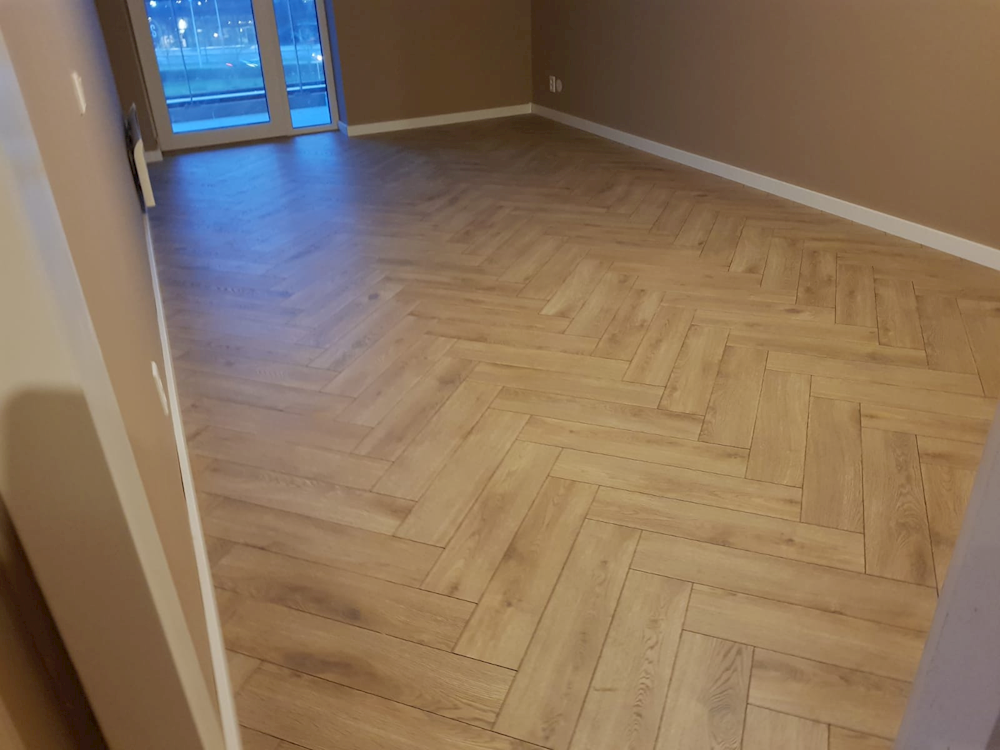
Installing a herringbone floor costs on average between €20 and €100 per m², depending on the chosen material such as PVC, laminate, or parquet. A herringbone floor is a type of flooring where planks are laid in a V-shaped pattern resembling fish bones, providing a classic and luxurious appearance. The costs are determined by factors such as the type of material, quality, and the number of square metres. In this price guide, you can read about the costs of a herringbone floor and what you should look out for.
How much does a herringbone floor cost?
Having a herringbone floor installed costs on average between €20 and €100 per m², depending on the chosen material. This price includes 21% VAT and labour. The cheapest option is vinyl (€20 to €80 per m²), while solid wood requires the highest investment (€50 to €100 per m²). For a PVC herringbone floor including installation, the price lies between €40 and €90 per m².
Herringbone floor costs per type
Type of herringbone floor | Costs per m² |
|---|---|
Vinyl floor | €20 to €80 |
Laminate floor | €25 to €60 |
PVC floor | €40 to €90 |
Solid wood floor | €50 to €100 |
The costs for installing a herringbone floor per m² vary mainly based on the chosen material. Vinyl is the most affordable option and ideal for those wanting a herringbone look without a large investment. Solid wood offers the highest quality and durability but comes with a higher price.
Installation costs for herringbone floors
Installation method | Costs per m² |
|---|---|
Floating installation | €10 to €20 |
Glued installation | €20 to €30 |
In addition to material costs, there are installation costs. For a PVC herringbone floor including installation, you pay for both the material and the installation. Floating installation is faster and cheaper, while gluing is more labour-intensive but provides a more stable finish. The total costs for a herringbone floor are determined by the surface area of the room multiplied by the price per square metre for material and labour.
All mentioned prices include 21% VAT and labour.
Herringbone floor costs per material type
The price of a herringbone floor depends heavily on the chosen material. Vinyl is the cheapest option starting from €20 per m², while solid wood requires the highest investment up to €100 per m². Each material has specific characteristics regarding durability, maintenance, and suitability for certain rooms.
Material | Costs per m² | Water-resistant | Lifespan | Suitable for |
|---|---|---|---|---|
Vinyl herringbone | €20 to €80 | Yes | 15-20 years | All rooms including damp rooms |
Laminate herringbone | €25 to €60 | No | 15 years | Dry rooms such as living rooms and bedrooms |
PVC herringbone | €40 to €90 | Yes | 20-25 years | Kitchens, bathrooms, and high loads |
Solid wood herringbone | €50 to €100 | No | Up to 50 years | Dry rooms, can be renovated multiple times |
Price-determining factors for a herringbone floor
The total price for installing a herringbone floor is determined by several factors besides the material itself. From the complexity of the pattern to the state of your subfloor, each aspect affects the final costs.
Laying pattern and complexity
The herringbone pattern is labour-intensive because planks are laid in a V-shaped pattern. This requires more precision and time than a straight laying direction. Rooms with many corners, niches, or irregular shapes increase costs further because more cutting and fitting is required.
Installation method
For a PVC herringbone floor including installation, you choose between floating or glued. Floating installation costs €10 to €20 per m² and is carried out faster. Gluing costs €20 to €30 per m² and requires more labour hours, but provides a more stable finish and works better with underfloor heating.
Condition of the subfloor
The subfloor must be flat, clean, and dry before a herringbone floor can be laid. If the subfloor needs to be levelled first or if there are moisture problems, additional material and labour costs will apply.
Underfloor heating
Not all materials are suitable for underfloor heating. PVC and vinyl conduct heat well and work perfectly with underfloor heating. Thick solid wood floors actually insulate and are less suitable. Glued floors provide better heat conduction than floating floors because there is no air layer in between.
Finishing and skirting boards
The choice of skirting boards, lacquers, oils, or waxes affects the costs of a herringbone floor. Solid wood floors often require a finishing layer. PVC and vinyl are ready-to-use and require no extra finishing.
Planning
Avoid last-minute bookings to keep costs manageable. Planning the installation well in advance helps in finding a professional at standard rates. Weekend work is generally more expensive than weekday work.
Surface area and material consumption
The costs for installing a herringbone floor per m² remain the same, but larger surfaces mean higher total costs. With herringbone patterns, there is more material loss due to cutting than with straight patterns, which increases consumption by 5 to 10 per cent.
Accessibility
If you live in an apartment on a higher floor without a lift, moving material takes extra time. Ensuring the workplace is clear and accessible allows the professional to start immediately, saving labour hours.
Region and travel distance
In large cities, prices are often higher due to operational costs. A local professional charges less travel time, which lowers the costs for having a herringbone floor installed.
Preventive maintenance
Do not delay small problems. Fixing a damaged subfloor or moisture damage before laying a new floor prevents more expensive repairs later.
Transparent price agreements
With a PVC herringbone floor including installation via Zoofy, you know what you pay upfront. There are no call-out charges. You pay a fixed price per square metre, including labour and VAT.
Preparation by the customer
The better you prepare, the faster the professional can work. Clear away furniture, remove old flooring if possible, and ensure free passage. This reduces labour time and therefore the total costs.
Additional costs and surcharges
The total costs for a herringbone floor can increase due to situation-specific extra work. At Zoofy, you pay no call-out charges.
Urgency surcharge: For urgent jobs, a surcharge often applies as the professional must adjust their schedule
Weekend surcharge: Work in the weekend is more expensive than during the week
Removing old floor: If the existing floor must be removed first, extra costs will apply
Levelling: An uneven subfloor must be levelled before the herringbone floor can be laid
Adjusting doors: Sometimes doors must be shortened because they no longer close properly after laying a new floor
Moisture barrier: In older homes, a moisture barrier might be necessary to prevent damp problems
How does the professional work when installing a herringbone floor?
Installing a PVC herringbone floor including installation follows a fixed sequence of steps.
Preparation: The professional assesses the subfloor for levelness and dryness. If necessary, the floor is levelled and old flooring is removed.
Acclimatisation: The flooring material must be left unpacked at room temperature for 48 to 72 hours. This prevents gaps and warping after installation.
Determining the starting point: The professional determines the starting point and laying direction. For herringbone, this is crucial for a symmetrical result.
Laying: The planks are laid piece by piece in the herringbone pattern. Special adhesive is used for gluing, while a foil underlay is used for floating installation.
Cutting and finishing: Around corners, door frames, and edges, planks are cut to size. Expansion joints are maintained for shrinkage and expansion.
Placing skirting boards: Skirting boards are mounted. The installation takes on average 1 to 3 days for a standard living room. Wait at least 24 hours before heavily using the floor.
How can you save on a herringbone floor?
There are several ways to save on a PVC herringbone floor including installation.
Maintain regularly: Vacuum daily, use felt gliders under furniture, and avoid standing water on laminate. Good maintenance significantly extends the lifespan.
Prepare: Clear the workspace and remove furniture from the room before the professional arrives. This saves labour hours.
Plan during the week: Do not book on the weekend and avoid urgent jobs. Planning during the week saves on surcharges for a herringbone floor.
Choose smart material: Vinyl and laminate are cheaper than solid wood. Consider if the durability of solid wood is worth the extra price for your situation.
Book via Zoofy: You get a fixed rate upfront, without call-out charges. You only pay after the job is completed.
Common problems with herringbone floors
Problems with herringbone floors can have various causes, from moisture fluctuations to wear and tear.
Gaps between planks
Gaps occur due to moisture fluctuations or temperature differences causing the material to shrink or expand. This happens mainly with wood and laminate when humidity is not stable between 40 and 60 per cent.
Loose planks
With floating floors, planks can come loose due to an uneven subfloor or a poor click connection. This causes instability. A levelled subfloor prevents this problem.
Discolouration from sunlight
Direct sunlight causes discolouration, especially in wooden floors. The wood fades unevenly. Sun protection or UV-resistant coatings can limit this process.
Find the best professional for your herringbone floor
Laying a herringbone floor is skilled work that requires precision and experience.
When to do it yourself: Only if you have experience laying floors and have a simple, rectangular room with a click-system material
When to hire a professional: For glued floors, complex rooms with many corners, solid wood floors, or when perfection is important
No call-out charges: You only pay for the work, never extra for the arrival of the professional
Fixed price upfront: You know what you pay for your floor installation, no surprises afterwards
Fast booking: Reserve a professional directly and choose a time
Payment via QR code after completion: You only pay when the job is done and you are satisfied
Reliable, vetted professionals: All professionals are verified and have experience with herringbone floors
Frequently asked questions about herringbone floors
What does a herringbone floor cost including installation?
A PVC herringbone floor including installation costs between €40 and €90 per m². Vinyl is cheaper (€20 to €80 per m²), laminate is between €25 and €60 per m², and solid wood costs €50 to €100 per m². The price includes 21% VAT and labour.
What does installing a 100 m² floor cost?
For 100 m², you pay between €2,000 and €10,000, depending on the material. Factor in 10-15% extra material for cutting loss with the herringbone pattern.
What does a 40 m² herringbone floor cost?
A 40 m² PVC herringbone floor including installation costs between €1,600 and €3,600. For vinyl, you pay €800 to €3,200, and for laminate €1,000 to €2,400.
Is a herringbone floor more expensive?
Yes, herringbone is more expensive than straight laying patterns due to complexity. The pattern requires more precision, time, and cutting work, which increases labour costs and material loss.
Book a professional for your herringbone floor
Ready to have your herringbone floor installed? At Zoofy, you can book a professional directly without quotes and without call-out charges. You will see exactly what it costs beforehand, and Zoofy connects you with a reliable, verified professional. You only pay once the work is finished.