
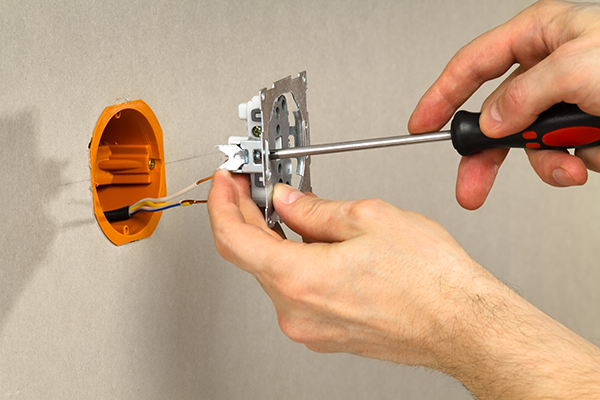
Replacing a socket costs on average between €70 and €350, depending on the type of socket and the complexity of the installation. An electrician removes the existing or defective socket and installs a new one according to current safety standards. In this price guide, you can read exactly what determines the costs for replacing a socket and what you should look out for when planning this task.
What does replacing a socket cost?
Replacing a socket costs an average of €200. Most jobs fall between €70 and €250, depending on the type of socket and the complexity of the installation. For more extensive adjustments, costs can rise to €350. These costs consist of materials and the electrician's labour hours.
Overview of average costs
Description | Price |
|---|---|
Average costs | €200 |
Typical range | €70 - €250 |
Low end - high end | €70 - €350 |
These prices provide a representative picture of what you can expect for standard replacement work. The final costs depend on your specific situation and the chosen material.
Material costs per component
Component | Price |
|---|---|
New socket (material) | €15 - €100 per project |
Holder | €3 - €50 per piece |
Standard socket | €4 - €7 per piece |
Socket with USB ports | €17 - €30 per piece |
Coaxial wall plate | €7 |
Material prices vary based on type and functionality. A standard socket is significantly cheaper than a model with extra features such as USB ports.
Electrician labour costs
Description | Price per hour |
|---|---|
Electrician hourly rate | €60 - €75 |
The electrician charges between €60 and €75 per hour for replacing a socket. Most replacement tasks are completed within one hour, unless unexpected complications arise. All mentioned prices include 21% VAT and labour costs. The affiliated professionals work according to current safety standards and ensure a safe installation.
Costs of replacing a socket per type
The costs for replacing a socket depend heavily on the type of socket you choose. A standard socket is the cheapest, while models with USB ports or moving an existing socket are more expensive.
Type of socket | Price |
|---|---|
Standard socket | €4 - €7 per piece |
Socket with USB ports | €17 - €30 per piece |
Coaxial wall plate | €7 per piece |
Moving a socket | €60 - €300 per project |
Price-determining factors for replacing a socket
The costs for replacing a socket vary per situation. What is a simple replacement for one job can require extra work and time for another. Below you can read which factors determine the price.
Type of socket
The type of socket directly determines the material costs. A standard socket costs €4 to €7 per piece, while a socket with USB ports costs €17 to €30. Special outlets for heavy appliances such as dryers, cookers or air conditioners also require more time and expertise during installation.
Number of sockets
For standard replacements, an electrician can replace up to 12 sockets per hour. Installing one new socket, on the other hand, can take up to two hours because this requires piping and more precise finishing. More sockets mean a longer working time and therefore higher costs.
Complexity and accessibility
Finished walls with plasterboard and insulation require extra work. The electrician must work carefully to prevent damage and may need to perform plasterboard repair. With visible walls without finishing, the job proceeds faster and the costs are lower.
Floor or ceiling installation
Concrete floors and floors above finished ceilings are harder to access. The professional must first determine the correct route and possibly make penetrations. Working above unfinished basements or crawl spaces requires less time and effort.
Moving a socket
Moving an existing socket costs between €60 and €300. The price depends on the distance, the condition of the walls and the type of socket. For larger moves, the electrician must perform more piping work and possibly fill holes.
Emergency versus planned
Emergency jobs cost more than planned work. The electrician must adjust their schedule and possibly reschedule other appointments. With a planned job, you can keep the costs better under control.
Weekend or weekdays
Work on the weekend is more expensive than on weekdays. This also applies to evening hours. Therefore, preferably plan your task on a weekday during office hours.
Region
In large cities, rates are often higher than in rural areas. This is due to higher operational costs and demand for electricians in urban environments.
Preparation and accessibility
Ensure the workspace is clear and accessible. Remove furniture and obstacles near the socket. Good access saves the electrician time, which reduces costs.
Postponement
Do not postpone tasks. A defective socket can pose a fire hazard and cause greater damage. Fixing small problems is more economical than repairing major damage.
Local professional
Local professionals can be on-site faster and save travel time. This can shorten the total project duration.
Transparent prices
Use a fair platform where you know what you pay in advance. At Zoofy, you get clear prices without surprises, so you can estimate the costs well.
Additional costs and surcharges
Extra costs are situation-dependent and at Zoofy you do not pay call-out charges.
Emergency jobs often have a surcharge because the professional must adjust their schedule
Work on the weekend is more expensive than during the week
Plasterboard repair involves extra costs if walls need to be opened
Moving a socket costs €60 to €300 extra, depending on the distance and the condition of the walls
These factors can increase costs, but by planning well in advance, unexpected costs remain limited.
How does the electrician work when replacing a socket?
Replacing a socket follows a fixed sequence of steps.
Preparation: The electrician first switches off the power via the distribution board to be able to work safely. This prevents electric shocks and damage to equipment.
Removing old socket: The old socket is unscrewed and the wiring is disconnected. The professional works carefully here so as not to damage the existing wires.
Checking wiring: The electrician checks whether the wiring is in good condition and meets safety requirements. Damaged wires are replaced before the new socket is installed.
Installing new socket: The new socket is connected to the wiring and secured in the flush-mounting box. The professional ensures a tight and secure attachment.
Testing: The electrician switches the power back on and tests whether the socket functions correctly.
A good electrician can replace up to 12 sockets per hour, while installing a single new socket can take up to two hours. Ensure the workspace is free of furniture and obstacles to keep costs low.
How can you save on replacing a socket?
There are several ways to reduce costs without compromising on quality.
Address problems early: Loose sockets or sparks indicate damage. Resolve this immediately to prevent larger repairs and higher costs.
Clear the workspace: Move furniture and obstacles before the electrician arrives. This saves the professional time and you money.
Plan on weekdays: Avoid weekend work and emergency jobs. Weekday work during office hours is significantly cheaper.
Combine multiple sockets: Have several sockets replaced at once. The electrician works more efficiently if they can do multiple sockets in a row, which reduces the cost per piece.
Book via Zoofy: You get a fixed rate in advance, without call-out charges and without surprises. You only pay after completion of the task.
Common causes of problems with sockets
Problems with sockets can have different causes.
Wear from years of use
Sockets wear out after years of use. The spring contacts lose their tension, causing plugs to fit looser and electrical contact to worsen. This can lead to sparks and heat development.
Overloading the socket
Too many appliances on one socket causes overheating. The wiring gets damaged and the socket can become defective. This significantly increases the fire hazard.
Outdated wiring
Old wiring no longer meets current safety standards. The insulation is often degraded, which can cause sparks and short circuits. Do not ignore these signals: a defective socket poses a fire hazard. Have problems resolved immediately by a qualified electrician.
Find the best electrician for replacing a socket
A reliable electrician is essential for electrical work, as incorrectly installed sockets can pose a fire hazard.
No call-out charges: At Zoofy you never pay call-out charges, making the total costs more transparent.
Fixed price in advance: You know what you pay beforehand, no surprises afterwards.
Quick booking without quote hassle: Book an electrician directly without requesting time-consuming quotes.
Payment via QR code after completion: You only pay when the job is completely finished and you are satisfied with the result.
Reliable, vetted professionals: All affiliated electricians at Zoofy are checked for quality and reliability, so you are assured of professional work.
Professional for replacing a socket
Ready to have a socket replaced? At Zoofy you book a professional directly, without quotes and without call-out charges. You see exactly what it costs in advance, and Zoofy connects you with a reliable professional who has been vetted. You only pay once the work is finished. Book a professional directly.
Useful links
Frequently asked questions
The average costs for replacing a socket are €200, with a typical range of €70 to €250. For more complex work, costs can rise to €350.
An electrician charges €60 to €75 per hour. Most standard replacements are completed within one hour, making the costs for one socket usually between €70 and €100.
An experienced electrician can replace up to 12 sockets per hour for standard work. Installing a completely new socket with new wiring can take up to two hours.
Yes, electrical work should only be performed by a qualified electrician. This is often necessary for safety reasons to avoid risks such as short circuits and fire hazards.
A socket with USB ports costs €17 to €30 for the material. The total costs are higher due to the electrician's labour costs.
Placing a new socket at the meter cupboard costs between €70 and €300, depending on the distance to the distribution board and the complexity of the piping.
Moving an existing socket costs €60 to €300, depending on the distance, the condition of the walls and the required piping.
No, at Zoofy you never pay call-out charges. You get a fixed price in advance and pay after completion of the job via QR code.
Replace a socket immediately in case of sparks, heat development, loose plugs or visible damage. This prevents fire hazards and greater damage.
A coaxial wall plate costs about €7 for the material. The total costs including installation depend on the complexity of the job.