
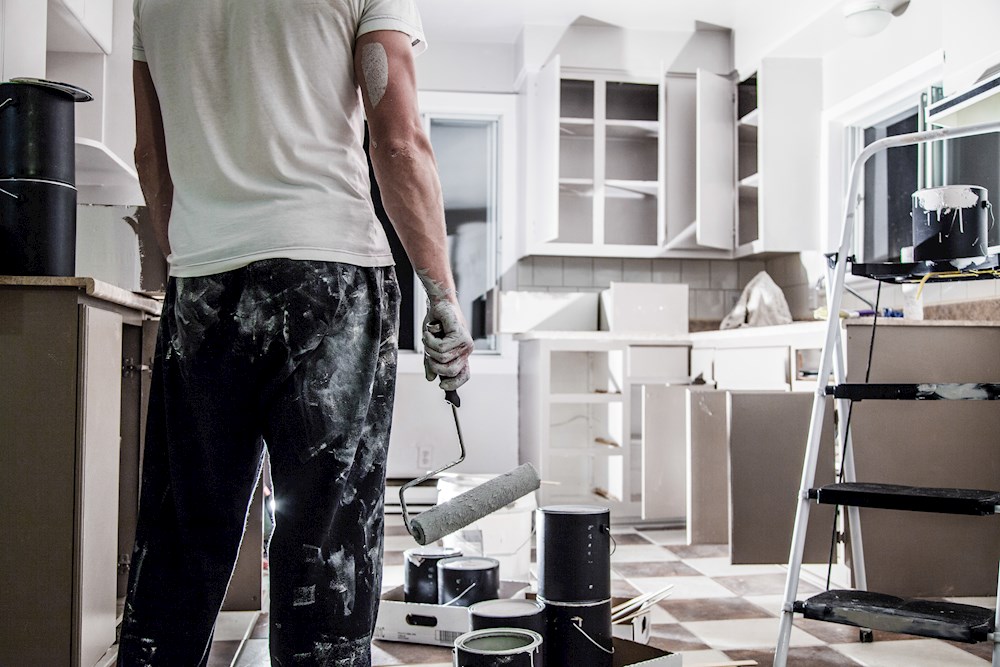
Having your kitchen cabinets painted costs on average between €700 and €5,000, depending on the size of your kitchen and whether you only have the cabinets or also the walls, ceiling, and window frames included. During this task, the doors, drawers, and fronts of your kitchen are given a new colour or finish by spraying or painting them, without you having to replace the entire kitchen. The costs for spraying kitchen cabinets are mainly determined by the number of elements, the type of paint, and the preparation time. In this price guide, you can read exactly what the costs are to have your kitchen painted and what you should look out for.
What does it cost to paint a kitchen?
Painting a standard kitchen four metres wide costs on average between €700 and €1,000. For a complete kitchen renovation including ceiling, doors, and window frames, costs range between €1,500 and €5,000. The costs for spraying kitchen cabinets are calculated per component or as a total project, depending on the number of elements you want to have painted and the surface area of your kitchen.
Costs per component
Type and size of kitchen door | Average price |
|---|---|
Kitchen door 40 x 60 centimetres | €40 to €70 |
Front of kitchen drawer | €25 to €50 |
Fridge door 40 x 180 centimetres | €75 to €100 |
Corner cabinet fronts | €65 to €90 |
Plinths per metre | €15 to €25 |
This table shows the costs per individual component. If you only want specific doors or fronts painted, you pay per element. Larger components such as fridge doors cost more due to the larger surface area.
Costs per task
Tasks | Average price |
|---|---|
Painting a four-metre wide kitchen | €700 to €1,000 |
Painting kitchen including ceiling and doors in the room | €1,500 to €3,000 |
Painting open kitchen including ceiling, doors, and frames in room | €2,000 to €5,000 |
The price to have your kitchen painted increases if you include the ceiling, doors, and window frames in the same room alongside the cabinets. In an open kitchen that flows into the living room, the entire space is often painted in one style, which increases the total price.
All mentioned prices include 21% VAT and labour.
Costs of kitchen painting per component
The costs for spraying kitchen cabinets depend on the number of components, the dimensions, and whether you also want to include the ceiling and window frames. Having only the cabinet doors painted costs from €40 per door, while an open kitchen including ceiling, doors, and frames can run up to €5,000. Below you can see what each component costs separately.
Component | Price |
|---|---|
Kitchen door 40 x 60 cm | €40 to €70 |
Front of kitchen drawer | €25 to €50 |
Fridge door 40 x 180 cm | €75 to €100 |
Corner cabinet fronts | €65 to €90 |
Plinths | €15 to €25 per metre |
Price-determining factors for kitchen painting
The costs to have your kitchen cabinets sprayed vary by situation. Factors such as the condition of your cabinets, the number of elements, and the chosen type of paint determine the final price. Below you can read which aspects influence the costs and why.
Number and size of components
The more kitchen cabinets, drawers, and doors you have, the more labour time is required. A small kitchen with ten doors requires less work than a large open kitchen with thirty elements. Each component must be prepared, painted, and finished, which increases the total costs.
Condition of the cabinets
Damaged cabinets with scratches, dents, or loose veneer require repair work before they can be painted. Sanding, filling, and repairing cost extra time. Well-maintained cabinets are faster to prepare, which saves labour and costs.
Type of material
Laminate, MDF, solid wood, and high-gloss surfaces each require a different approach. Laminate must be thoroughly degreased and lightly sanded for good adhesion. High-gloss cabinets and surfaces with relief require special pre-treatment, which increases the costs.
Paint type and finish
The choice between acrylic, alkyd, or 2-component lacquer influences the price. The finish also plays a role: matte, satin, or high-gloss. High-quality wear-resistant paint is more expensive to purchase but lasts longer and provides a better result, especially in intensively used kitchens.
Painting technique
Spraying gives a smoother, more professional result but requires special equipment and extensive masking time. Traditional painting with a brush or roller can be cheaper for smaller projects, but the end result is less even. With spraying, you pay more for material and preparation.
Complexity of the preparation
Old layers of paint sometimes need to be completely removed for a durable result. Greasy surfaces around the stove require intensive cleaning with degreaser. These preparation steps cost extra labour time and increase the total price.
Scope of the project
Only painting the cabinet doors is cheaper than a complete renovation. If you also include the ceiling, walls, doors, and window frames, the costs rise but you get a cohesive result. In an open kitchen, the entire space is often painted.
Region
In large cities, prices are often higher than in rural areas due to higher labour costs. The price to have your kitchen painted in Amsterdam or Rotterdam can be ten to twenty per cent higher than in smaller towns.
Planning and urgency
Urgent jobs cost more than planned work. If you need the professional at short notice, you pay a surcharge. Plan the painting well in advance for the best price.
Weekend versus weekdays
Work in the weekend is more expensive than during the week. If you are flexible, choose a weekday to save on costs.
Accessibility and preparation
Empty cabinets and a cleared workspace save labour time. If the professional does not have to wait or move furniture themselves, the work goes faster and costs stay lower.
Additional costs and surcharges
Extra costs are situation-dependent. At Zoofy, you do not pay call-out charges, which immediately saves on the total costs.
For urgent jobs, a surcharge applies because the professional must adjust their planning to help you quickly
Work in the weekend is more expensive than during the week due to irregular working hours
Damage such as dents or scratches that must first be repaired involves additional work
Including the ceiling, walls, or window frames increases the total costs but provides a complete result
How does the professional work when painting a kitchen?
The job follows a number of fixed steps that ensure a durable and professional result.
Preparing workspace: The professional protects the floor and the countertop with covering material and masks parts not to be painted.
Dismantling: Kitchen cabinet doors, drawers, and fronts are dismantled. Handles, hardware, and hinges are removed so they are not painted.
Cleaning and degreasing: All surfaces are thoroughly cleaned and degreased. Kitchen cabinets often have a layer of grease from cooking vapours that must first be removed.
Sanding and repairing: Old paint is sanded and damages such as scratches or dents are repaired and filled for a smooth surface.
Applying primer: A base coat ensures good adhesion of the paint to the material.
Painting or spraying: The paint layers are applied with special equipment for a smooth result. Usually, two to three layers of paint are needed with sufficient drying time in between.
Assembling: After curing, the doors and drawers are replaced, including hardware and handles. A standard kitchen takes on average two to four days of work, depending on the number of elements and the drying time.
How can you save on kitchen painting?
There are several ways to lower the costs without sacrificing quality.
Address small damages promptly: Repairing a scratch now is cheaper than having to treat the entire door again later. This prevents you from paying higher costs for extra repair work.
Clear the workspace: Empty the kitchen cabinets and ensure the professional can get straight to work. This saves labour time and lowers the total costs.
Choose a weekday: Do not book in the weekend or with urgency. Scheduled weekday work is more economical than urgent jobs.
Maintain painted cabinets well: Clean them with a mild cleaning agent and avoid abrasives. This way they last five to ten years without a new paint job.
Combine tasks: Have cabinets, ceiling, and walls done in one project. The professional then only has to come once, which saves in the total price.
Book via Zoofy: You get a fixed rate in advance, without call-out charges and without surprises. You only pay after completion of the job.
When is painting kitchen cabinets not a good idea?
Not every kitchen is suitable for painting.
Severe damage and moisture damage
In cases of MDF swelling, peeling veneer, or moisture damage, painting does not offer a sustainable solution. The paint temporarily masks the problem, but the underlying damage expands. Moisture damage can be recognised by swelling, discolouration, or mould formation.
Unsuitable materials
High-gloss laminate and cabinets with relief patterns require special pre-treatment. Without the right approach, the paint can peel or adhere unevenly, which does not justify the investment.
Age and construction
With kitchen cabinets older than 15 to 20 years with a shaky construction, replacement is often a better investment. Painting then only extends the lifespan to a limited extent.
Find the best painter for your kitchen
Painting kitchen cabinets requires craftsmanship, good preparation, and the right materials.
No call-out charges: At Zoofy, you never pay extra for the arrival of the painter, which immediately saves on the total costs.
Fixed price in advance: You know exactly what the costs are before the professional begins, without surprises afterwards.
Quick booking without quote hassle: Book a professional directly without first requesting multiple quotes, so your kitchen is refurbished quickly.
Payment via QR code after completion: You only pay when the work is finished and you are satisfied with the result.
Reliable, verified professionals: All painters are checked for craftsmanship and reliability, so you can be sure that the job is carried out professionally.
Expert advice: An experienced painter can advise you on the best type of paint for your situation and whether spraying or brushwork gives the best result for your type of kitchen.
Book a painter for your kitchen
Ready to have your kitchen cabinets sprayed or painted? At Zoofy, you book a professional directly, without quotes and without call-out charges. You see exactly what it costs beforehand, and Zoofy pairs you with a reliable painter who has been verified. You only pay once the work is done. Book a painter directly now.
Useful links
Frequently asked questions
A standard kitchen four metres wide costs between €700 and €1,000. For a complete renovation including ceiling, doors, and window frames, costs range between €1,500 and €5,000. The price depends on the number of cabinets and the scope of the project.
Painting gives a more durable result and more colour options. Wrapping is faster but less resistant to heat and moisture, especially around the stove. For a long-lasting result, most people choose painting.
Yes, but high-gloss surfaces require extra preparation such as sanding and applying a special primer for good adhesion. This slightly increases the costs due to the extra labour time.
Yes, this is possible. The painter then applies an opaque primer and several layers of paint so that the old colour does not show through. This does require extra layers of paint and time.
Usually, two to three layers of paint are needed for a nice opaque and durable result. The exact number depends on the material and the desired finish.
With proper maintenance, a painted kitchen lasts on average five to ten years. The lifespan depends on the paint quality and how intensively you use the cabinets.
The kitchen is limited in its use during the work. The cabinets are dismantled and there is a smell of paint. Plan for this and ensure an alternative cooking option.
Spraying gives a smoother, more professional finish but costs more in preparation. Brushwork may be more suitable for smaller projects or certain surfaces.
Wear-resistant lacquer paint such as acrylic or 2-component lacquer is best. These paints are resistant to moisture, grease, and heavy use, which is important in intensively used kitchens.
Hinges and hardware are dismantled before painting and reassembled afterwards. This is usually included in the price.