
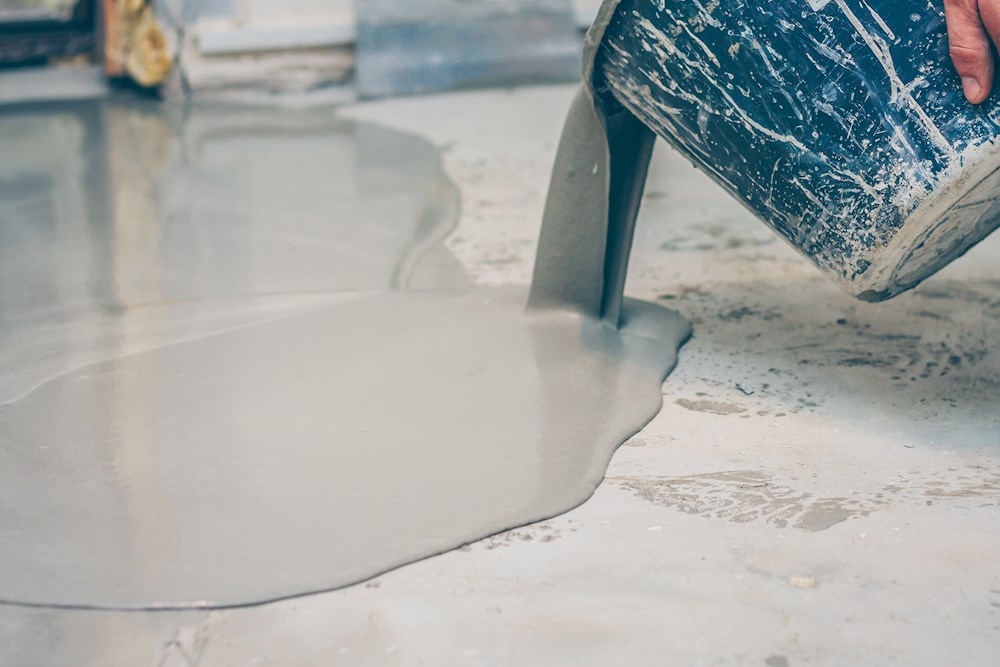
Levelling a floor costs an average of €10 to €75 per square metre, depending on the condition of the surface and the type of levelling compound. Floor levelling involves making a surface flat with a levelling compound, which is necessary before laying a new floor such as laminate, parquet, or tiles. The price is influenced by factors such as the height difference in the floor, the surface area, and the accessibility of the space. In this price guide, you can read about the costs of floor levelling and what to look for when planning this task.
What does floor levelling cost?
Floor levelling costs an average of €10 to €75 per square metre. The exact costs depend on the condition and type of substrate, the thickness of the required levelling layer, and the size of the room. Levelling a concrete floor is usually more affordable than treating a wooden surface, as concrete provides a more stable base.
Overview of floor levelling costs
Description | Price |
|---|---|
Floor levelling general | €10-€75 per m² |
This price overview shows the total range for levelling a floor. The final costs per square metre are determined by the specific type of substrate and the amount of levelling compound required.
Costs per floor type
Floor type | Costs per m² |
|---|---|
Levelling concrete floor | €13-€33 per m² |
Levelling wooden floor | €45-€75 per m² |
The costs for levelling a concrete floor are lower because this substrate usually requires less preparation. A wooden floor often requires extra pre-treatment and thicker layers to guarantee a stable result.
Costs per thickness of levelling compound
Number of millimetres | Costs per m² |
|---|---|
Up to 1 millimetre | €7-€8 per m² |
1 and 2 millimetres | €10-€12 per m² |
Above 2 millimetres | €15-€18 per m² |
The thickness of the levelling layer directly determines the amount of material and the number of operations. For larger height differences, more levelling compound is needed, which increases the price per square metre. All mentioned prices are including 21% VAT and labour from the affiliated professionals.
Price-determining factors for floor levelling
The costs for levelling a floor vary per project because every house has a different situation. Below you can read which factors influence the price and why some jobs require more time and material than others.
Type of substrate
Levelling a concrete floor requires less pre-treatment than a wooden floor. Concrete is stable and flat, allowing the levelling compound to be applied directly. With a wooden floor, loose parts must first be screwed down and the surface must be sanded for good adhesion. These extra preparations increase the required labour time.
Thickness of the levelling layer
The greater the height difference in your floor, the thicker the layer of levelling compound must be. A thin layer up to 1 millimetre requires less material and dries faster. For differences above 2 millimetres, more levelling compound is needed, the layer may need to be applied in several stages, and drying takes longer. This increases both material costs and labour time.
Condition of the substrate
A floor with cracks, holes, or loose parts requires more preparatory work. These damages must be repaired before the levelling compound can be applied, otherwise the layer will not adhere properly or problems will arise later. More preparation time means higher costs.
Floor level and accessibility
Heavy bags of levelling compound and mixing tanks are needed for floor levelling. On the ground floor, material can be brought directly inside. On higher floors, everything must go up via the stairwell or a lift, which costs extra time and physical effort. This increases the total labour time and therefore the price.
Shape of the room
A rectangular room is easy to level because the compound can be distributed smoothly. Rooms with many corners, niches, or protrusions require more precision work and longer finishing along the edges. This increases the required labour time per square metre.
Moisture level of the substrate
Levelling compound only adheres to a dry surface. If the floor is too damp, a moisture barrier or vapour barrier must first be applied or the moisture problem must be solved. This extra step increases both material and labour costs before levelling can begin.
Underfloor heating
Special heat-resistant levelling compound is required for underfloor heating, which is more expensive than standard compound. In addition, the heating must be switched off during application and drying, which affects the planning. The special compound and longer drying time increase the total costs.
Removing old floor covering
If there is still an old floor such as laminate, carpet, or tiles, it often needs to be removed first. Removing and disposing of old material costs extra time and labour, which is factored into the total price.
Urgency and planning
An urgent task requires the professional to reschedule other appointments. A planned task during the week allows the professional to plan the work efficiently, keeping the costs lower.
Weekend and evening work
Work in the weekend or in the evening costs more than weekday tasks during the day. This is because the professional is deployed outside regular working hours.
Region
In large cities, the costs for levelling a floor are often higher than in rural areas. This is due to higher operational costs and greater demand for professionals in urban regions.
Additional costs and surcharges
Extra costs when levelling a floor are situation-dependent. At Zoofy you do not pay call-out charges.
Urgency surcharge: A surcharge often applies to urgent tasks.
Weekend surcharge: Work at the weekend is more expensive than during the week.
Difficult floor shape: For rooms with protrusions or niches, an additional price of approximately €25 per square metre applies.
Removing laminate: Costs €3-€5 per m².
Removing carpet: Costs €20-€65 per hour.
Disposal of debris and floor insulation: These can incur extra costs.
How does the professional work when levelling a floor?
Floor levelling follows a fixed sequence of preparation, application, and drying.
Prepare substrate: The professional makes the floor clean, dry, and dust-free. Cracks and holes are filled with filler. For a concrete floor, holes are closed with cement and primer is applied for good adhesion. For a wooden floor, loose parts are screwed down and unevennesses are sanded away. For a tiled floor, the floor is made grease-free with a degreasing agent. Foam tape is applied along the walls to allow for expansion.
Mix and apply compound: The levelling compound is mixed with the correct water ratio in a mixing bucket. After pouring, a spiked roller is immediately rolled over the compound to remove air bubbles and ensure a smooth surface.
Allow to dry: Drying time is approximately 1 day per millimetre of thickness of the levelling layer. After a few hours, the floor is often walkable. The optimal working temperature is between 15-25°C with good ventilation but without draughts.
How can you save on floor levelling?
There are several ways to save on the costs for levelling your floor.
Address problems early: Fixing small unevennesses is more affordable than repairing major damage. By intervening in time, you prevent the need for a thick layer of compound, which reduces costs.
Prepare the workspace: Remove furniture and obstacles before the professional arrives. Ensure the space is clear and accessible so that no time is lost on preparation.
Choose the right time: Plan the work during the week and in a period when you do not need the space for a few days to avoid surcharges.
Book via Zoofy: You get a fixed rate in advance, without call-out charges and without surprises. You only pay after completion of the job.
Common problems with floor levelling
Problems when levelling a floor arise from careless preparation or incorrect execution.
Air bubbles in compound
Air bubbles occur when the levelling compound is insufficiently de-aerated with a spiked roller. This creates an uneven surface with small pits or bumps, meaning the new floor will not lie flat and will be damaged more quickly.
Cracks in the layer
Cracks occur due to an incorrect mixing ratio, drying too quickly, or extreme temperatures during drying. The compound then contracts and cracks, causing the strength and flatness of the substrate to disappear.
Detachment of the levelling layer
The layer detaches due to insufficient preparation of the substrate or existing moisture problems. Without good adhesion, hollow spots occur that later break, requiring costly repair work before a new floor can be laid.
Find the best professional for floor levelling
Floor levelling is specialist work where mistakes are costly.
No call-out charges: You never pay extra for the professional's arrival, only for the work itself.
Fixed price in advance: You know exactly what the costs are, without surprises afterwards.
Book quickly without quote hassle: Directly choose a time and book a professional, without waiting for quotes.
Payment via QR code after completion: You only pay when the job is completely finished and you are satisfied.
Reliable, screened professionals: All affiliated professionals are thoroughly screened for experience and reliability.
Specialist knowledge required: An incorrect mixing ratio or insufficient de-aeration is often impossible to repair without removing the entire layer, which doubles the costs. Therefore, it is important to choose an experienced professional who does it right the first time.
Book a professional for floor levelling
Thinking about having your floor levelled? At Zoofy, you can book a professional directly, without quotes and without call-out charges. You can see exactly what it costs in advance, and Zoofy connects you with a reliable, screened professional. You only pay once the work is done.
Useful links
Frequently asked questions
Floor levelling costs an average of €10 to €75 per square metre. The exact costs per square metre depend on the type of substrate and the thickness of the required levelling layer. Levelling a concrete floor costs between €13-€33 per m², while a wooden floor costs €45-€75 per m².
The costs for floor levelling are between €10-€75 per m². The total costs for a PVC floor including levelling and installation depend on the type of PVC you choose and the size of the room. For an accurate quote, you can book a professional directly via Zoofy.
Levelling compound is a liquid or paste-like mass used to make a substrate flat. There are different types such as self-levelling compound, quick-drying compound, and pourable compound.
Equalising is intended for smoothing small unevennesses and height differences up to about 3 centimetres. Levelling is for large height differences above 3 centimetres and requires other techniques or materials such as sand-cement screeds.
No, the compound must first dry completely. Count on 1 day of drying time per millimetre of layer thickness. After a few hours, the floor is walkable, but for laying a new floor, you must adhere to the full drying time.
Yes, well-bonded tiles can serve as a substrate after thorough cleaning and degreasing with a degreasing agent. Loose, damaged, or hollow tiles must first be removed, otherwise the levelling layer will detach later.
Not mandatory, but highly recommended. With underfloor heating, special heat-resistant levelling compound is needed that conducts heat well. The heating must be switched off during application and drying of the layer.
This depends on the thickness of the layer. At 1 millimetre thickness, you can level approximately 15-17 square metres with 25 kilograms of compound. At 2 millimetres thickness, this becomes about 7-8 square metres.
Yes, for larger height differences, multiple layers can be applied. Each layer must first dry completely before the next is applied. This does extend the total turnaround time of the job.
Levelling compound is intended as a substrate, not as a finishing floor. Without a protective layer, it is sensitive to scratches, stains, and moisture. A top layer such as laminate, PVC, or tiles is always needed for a durable finish.