
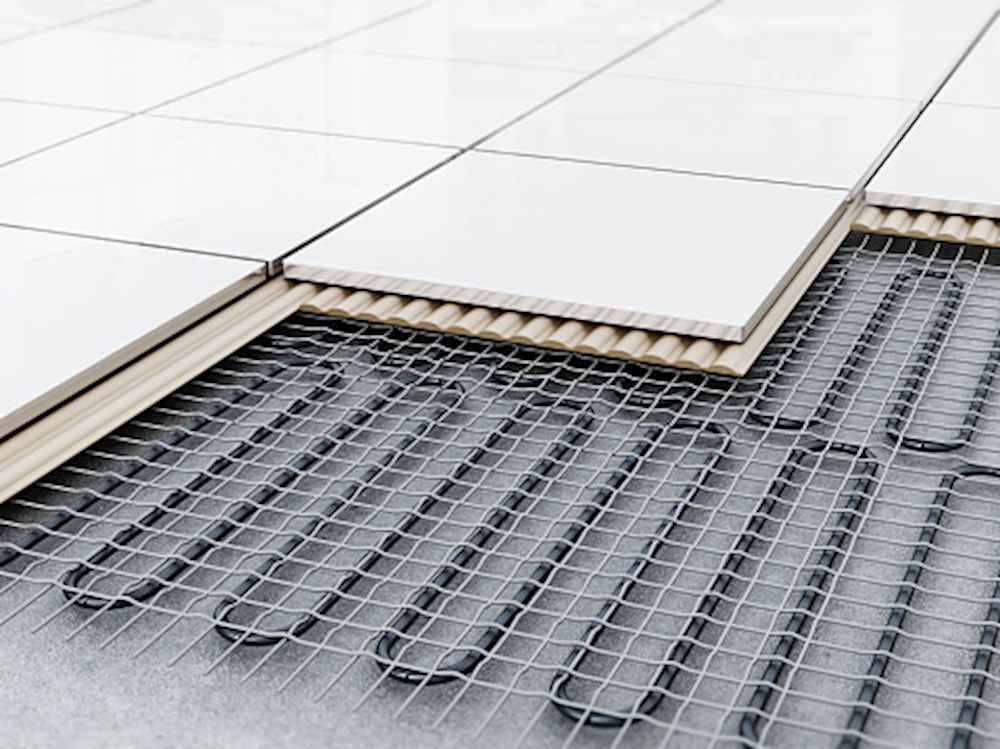
The cost of installing underfloor heating averages between €850 and €2,650, depending on the surface area and the type of system you choose. Underfloor heating involves installing a network of pipes in the floor that distributes heat evenly throughout the room, providing a comfortable indoor climate without visible radiators. Costs are primarily determined by the size of the room, the type of system (wet or dry underfloor heating), and the complexity of the installation. In this price guide, you can read exactly what underfloor heating installation costs and what to look out for when choosing for your situation.
How much does underfloor heating installation cost?
The average cost for installing underfloor heating is between €850 and €2,650, depending on the area you want to heat. These costs include materials, labour, and 21% VAT. For smaller rooms up to 20 m², the price ranges between €850 and €1,100, while larger areas up to 90 m² cost between €2,600 and €2,650. The average hourly rate of the connected professionals is €65 per hour.
Underfloor heating milling costs per surface area
Surface area (Main heating) | Surface area (Extended auxiliary) | Surface area (Standard auxiliary) | Price |
|---|---|---|---|
up to 10 m² | up to 15 m² | up to 20 m² | €950 - €1,100 |
up to 20 m² | up to 30 m² | up to 40 m² | €850 - €950 |
up to 30 m² | up to 45 m² | up to 60 m² | €1.250 - €1.400 |
up to 40 m² | up to 60 m² | up to 80 m² | €1.450 - €1.500 |
up to 50 m² | up to 75 m² | up to 100 m² | €1.550 - €1.650 |
up to 60 m² | up to 90 m² | up to 120 m² | €1.800 - €2.000 |
up to 70 m² | up to 105 m² | up to 140 m² | €2.150 - €2.300 |
up to 80 m² | up to 120 m² | up to 160 m² | €2.300 - €2.450 |
up to 90 m² | up to 135 m² | up to 180 m² | €2.600 - €2.650 |
The table shows that the costs for milling and installing underfloor heating increase as the surface area gets larger. The first column indicates the area for main heating, the second for extended auxiliary heating, and the third for standard auxiliary heating. Main heating is intended as the primary heat source, while auxiliary heating complements existing radiators. The costs per m² are rounded based on the total price and vary between €43 and €65 per square metre, including VAT, materials, and labour.
Costs of electric underfloor heating
Electric underfloor heating is mainly used in smaller spaces such as bathrooms and should not serve as main heating. The costs for electric systems consist of material prices and labour at €65 per hour. For a 4 m² bathroom, you pay €150 for materials, while larger areas up to 20 m² cost €400.
Power | Surface area (12 cm spacing) | Material price |
|---|---|---|
320 Watt | 2 m² | €130 |
520 Watt | 4 m² | €150 |
730 Watt | 5 m² | €175 |
930 Watt | 6 m² | €200 |
1080 Watt | 16 m² | €230 |
1760 Watt | 13 m² | €270 |
2070 Watt | 16 m² | €325 |
2350 Watt | 20 m² | €400 |
Price-determining factors for underfloor heating installation
The costs for installing underfloor heating vary by situation. Below you can read which factors influence the price.
Surface area of the room
The larger the surface area to be heated, the more pipes and materials are required. This increases both material costs and labour time. For main heating, pipes are laid closer together (10 cm centre-to-centre distance) than for auxiliary heating (20 cm centre-to-centre distance). A larger space also requires more time for milling grooves and laying pipes.
Type of system
Water-based and electric underfloor heating differ significantly in material costs and installation time. Water-based systems are more complex as they connect to the central heating boiler and require a manifold. Electric systems are simpler to install but only suitable for small areas like bathrooms.
Installation method
Milling underfloor heating into an existing floor involves less disruption and is often more affordable than installation in a screed floor or with an overlay system. Milling saves building height and avoids having to replace the entire floor.
Existing situation versus new build
In new builds, pipes can be integrated directly into the floor. In existing floors, extra work such as levelling, applying insulation, or removing old flooring may be necessary, increasing total costs.
Urgency versus planned work
Urgent jobs cost more than planned work because the professional must adjust their schedule to be available quickly. Regular work allows for more efficient planning and material ordering.
Weekend and evening work
Work during the weekend or in the evening is more expensive than weekday work due to higher rates outside regular working hours.
Complexity of the space
Rooms with many corners or large glass facades require more time. Near glass, pipes are often laid closer together to counteract cold radiation, increasing pipe length and labour time.
Required materials
The price of insulation material, pipes, and the manifold differs by brand and quality. High-quality insulation retains heat better but costs more.
Region
In large cities, costs may be higher due to transport, parking, and general urban pricing levels.
Preparation of the workspace
If the workspace is prepared, the professional can start immediately. Removing furniture and old flooring beforehand saves labour time.
Booking time
Tasks scheduled early are often more economical. Addressing small issues early prevents larger, more expensive repairs later.
Additional costs and surcharges
Additional costs depend on your specific situation. At Zoofy, you do not pay call-out charges.
Urgent job: A surcharge applies for urgent jobs to accommodate immediate availability.
Weekend work: Weekend work is more expensive due to higher out-of-hours rates.
Floor levelling: After milling, levelling the floor may be necessary, which is considered additional work.
Shortening doors: With overlay systems on existing wooden floors, you might need to shorten doors.
Manifold and thermostat: The purchase of a manifold and thermostat sometimes falls outside the standard quote.
How the professional works when installing underfloor heating
The installation of underfloor heating follows a set number of steps, from preparation to finishing.
Preparation and inspection: The professional assesses the situation and determines the best installation method. They check if the substrate is level and dry.
Applying insulation: An insulation layer is applied to limit heat loss downwards. Edge insulation prevents cracks due to expansion. For milling, grooves 17 millimetres deep are created.
Laying pipes: Synthetic pipes are laid in a snail-shell pattern or a hairpin pattern near glass. They are secured with clips or rails.
Connection and testing: Pipes are connected to the manifold and the system is pressure-tested for leaks before the floor is finished.
Finishing: The floor is levelled and a screed is applied, followed by the final floor covering.
How to save on underfloor heating installation
There are several ways to reduce the costs of installing underfloor heating without compromising on quality.
Choose milling: Milling is more affordable than traditional installation in a screed. It saves height and labour time.
Prepare the workspace: Remove furniture and old flooring yourself before the professional arrives.
Plan on weekdays: Avoid booking in the weekend or as an urgent task to stay away from high surcharges.
Combine tasks: Have floor insulation, levelling, and other preparations done at once to avoid multiple call-outs.
Book via Zoofy: You get a fixed rate upfront, no call-out charges, and you only pay after the job is completed.
Find the best professional for underfloor heating installation
Installing underfloor heating is specialist work; incorrect installation can lead to leaks or uneven heating.
No call-out charges: You only pay for the work performed.
Fixed price upfront: You know exactly what the costs are without surprises.
Quick booking without quote hassle: Provide three moments and a professional will visit.
Payment via QR code after completion: Pay only when the job is done and you are satisfied.
Reliable, vetted professionals: All connected professionals are verified for competence.
High customer satisfaction: Zoofy scores a 9.2 with customers due to quality and reliability.
Book a professional for underfloor heating installation
Ready to have underfloor heating installed? At Zoofy, you can book a professional directly without quotes and without call-out charges. You will see exactly what it costs beforehand. Pay only when the work is finished. Book a professional directly.
Useful links
Frequently asked questions
The costs for installing underfloor heating range between €43 and €65 per square metre, including materials and labour.
For a 100 m² surface, costs are around €1,650, depending on its use as main or auxiliary heating.
For 50 m², you pay an average of between €1,550 and €1,650, depending on the system type and installation method.
Underfloor heating itself is not eligible, but in combination with a heat pump, you can receive the ISDE subsidy.
Yes, such a home is more attractive to buyers for its comfort, energy savings, and modern appearance.
Yes, it can be milled into concrete or tiles, laid on a subfloor, or installed as an overlay system on wood.
Main heating has pipes spaced 10 cm apart and replaces radiators. Auxiliary heating has a 20 cm spacing and complements existing heating.
Milling takes 1 to 2 days. Traditional installation takes longer due to the drying time of the screed.
Yes, it is ideal as it works efficiently at lower flow temperatures.
Tiles and natural stone conduct heat best. Laminate and parquet can also be used if they are marked as suitable.