
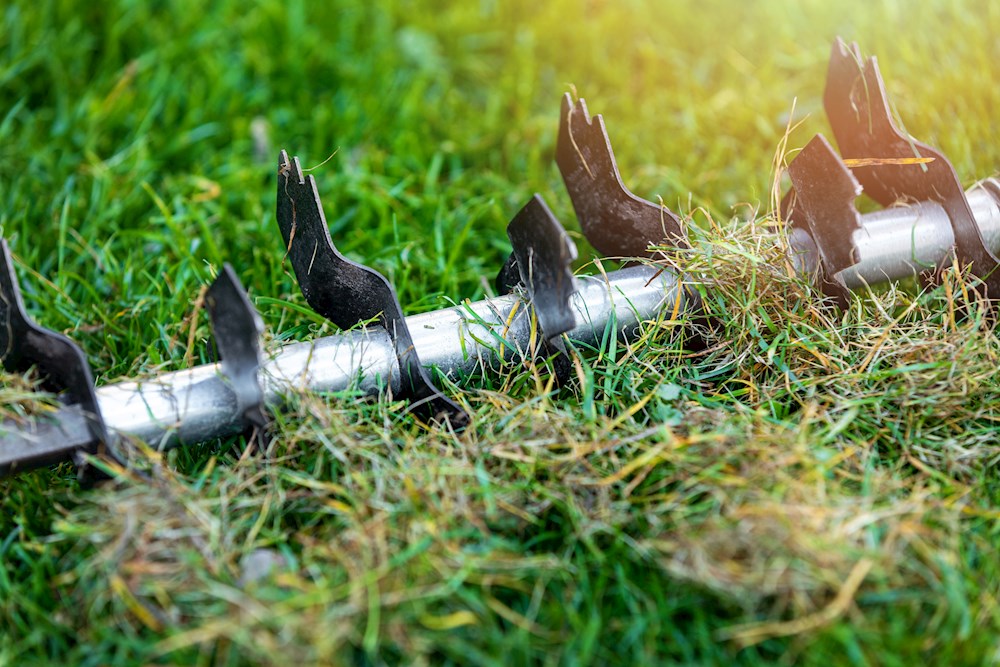
Scarifying grass costs on average between €100 and €150 for a lawn of 100 m². Scarifying is a lawn maintenance technique where blades cut into the soil to remove thatch, moss, and dead organic material, allowing your lawn to breathe again. In this price guide, you can read exactly what determines the costs for scarifying grass and what to look out for with this task.
What does scarifying grass cost?
Scarifying grass costs on average between €100 and €150 for a lawn of 100 m². This amount is inclusive of labour and VAT. The costs for scarifying grass depend on the surface area of your lawn and the condition of the soil. With a heavily thatched lawn with a lot of moss and felt, the job may take slightly longer, which can influence the price.
Lawn maintenance price overview
Job | Price |
|---|---|
Scarifying lawn (100 m²) | €100 - €150 |
Mowing lawn (100 m²) | €25 - €30 |
Gardener costs | €50 - €55 per hour |
The table shows that the costs for scarifying are higher than for a simple mow. This is because scarifying is more intensive work: the machine cuts into the ground, removes organic material, and must be passed over the entire lawn. For a more extensive mow, for example with disposal of grass waste, you pay between €30 and €40.
The hourly rate of a gardener is between €50 and €55. For scarifying a lawn, a fixed price per surface area is often agreed upon because the time is fairly predictable. Do you have a lawn larger than 100 m²? Then you can calculate the costs per m² to make an estimate.
Please note: all mentioned prices include 21% VAT and labour. These are indicative prices based on previously performed jobs via Zoofy.
Additional costs for disposal and edge cutting
In addition to the basic price for scarifying itself, you can choose additional services such as disposing of material or cutting the edges of your lawn. Disposing of scarification waste costs more than grass disposal after mowing because the removed material (moss, dead grass, and thatch) has quite a lot of volume. Below you can see what these extra options cost.
Extra service | Price |
|---|---|
Disposing of grass when mowing | €3 - €4 per 25 m² |
Disposing of scarification waste | €5 - €6 per 25 m² |
Edge cutting | €0.65 - €1 per metre |
Price-determining factors for scarifying grass
The costs for scarifying grass are determined by various factors. Below you can read exactly what influences the price and what you can take into account.
Surface area of the lawn
The larger your lawn, the more time the job takes. Costs are often calculated per 100 m². A lawn of 200 m² requires twice as much work as a lawn of 100 m², which directly affects the price.
Condition of the lawn
A heavily neglected lawn with a thick thatch layer and a lot of moss requires more time and potentially multiple treatments. The machine must cut deeper and remove more material, which extends the labour time.
Type of machine
An electric scarifier is suitable for small areas and cheaper to use. A petrol scarifier is more powerful and is used for larger lawns, but costs more. The professional chooses the right machine based on your situation.
Soil type
Lawns on clay soil retain more moisture, allowing moss to develop more quickly. This often means more work during scarifying. On sandy soil, the ground is airier and thatch forms less quickly.
Frequency of scarifying
Intensively used lawns or lawns on damp soil need maintenance more often, sometimes twice a year. If your lawn hasn't been scarified for a long time, the thatch layer is thicker and the job takes more time.
Urgency versus planned work
Urgent jobs are more expensive because the gardener has to adjust their planning. Scarifying can usually be planned well in advance, which saves costs.
Weekend or weekdays
Work at the weekend costs more than during the week. Plan your job on a weekday if you want to limit the costs.
Disposal of scarification waste
Disposing of removed moss and thatch increases the price. This material takes up more volume than mown grass, making disposal costs higher.
Overseeding and fertilising
After scarifying, you can choose to overseed bare patches or fertilise. These extra services increase the total price but ensure a faster recovery of your lawn.
Accessibility and preparation
Ensure your lawn is mown short before the gardener arrives. This saves time. A free workspace without obstacles also helps the job run more smoothly.
Region
In large cities, costs are often slightly higher than in rural areas. This is related to higher costs for transport and parking.
Local professional
A local gardener can be on-site faster and knows the soil conditions in your region. This can offer practical advantages.
Transparent prices
At Zoofy, you know in advance what you pay for scarifying your lawn, without surprises afterwards and without call-out charges.
Extra costs and surcharges
Extra costs depend on your situation. At Zoofy, you pay no call-out charges.
Urgency surcharge: For urgent jobs, a surcharge often applies because the gardener must adjust their planning.
Weekend surcharge: Work at the weekend is more expensive than during the week.
Disposal costs: Disposing of scarification waste costs €5 to €6 per 25 m². Disposing of grass after mowing costs €3 to €4 per 25 m².
Edge cutting: Extra edge cutting costs €0.65 to €1 per metre.
Heavily neglected lawns: For lawns with extreme thatch formation, additional measures such as overseeding or soil improvement may be necessary, which increases the costs.
How does the gardener work when scarifying grass?
Scarifying your lawn follows a fixed set of steps for an optimal result.
Preparation: The connected professional first mows the grass short, often to about 4 centimetres. This is essential so that the scarifier can work effectively and the blades can reach the ground properly.
Setting the machine: The scarifier is set to the correct depth, depending on the condition of the lawn and the thickness of the thatch layer. With a heavily thatched lawn, the cut is deeper.
Scarifying: The lawn is treated in two crossing directions for an even result. The blades cut into the soil and remove thatch, moss, and dead organic material, so your lawn can breathe again.
Cleaning up: The loosened scarification waste is removed. This material can go on the compost or be disposed of by the gardener. Disposal increases the costs by approximately €5 to €6 per 25 m².
Aftercare: Bare patches can be overseeded. The professional often advises fertilising and regular watering for quick recovery. For a lawn of 100 m², the full job takes a few hours.
How can you save on scarifying grass?
There are several ways to limit the costs for scarifying your lawn.
Scarify regularly: Do this at least once a year. A thin thatch layer is faster to remove than a thick, neglected layer, keeping the labour time shorter.
Mow the grass short beforehand: Ensure the lawn is mown short before the gardener arrives. This saves time and therefore reduces the costs.
Choose a weekday: Do not book at the weekend or with urgency. Weekday, planned work is more economical and saves on surcharges.
Combine jobs: Have scarifying coincide with mowing or other garden maintenance tasks for more efficiency.
Book via Zoofy: You get a fixed rate in advance, without call-out charges and without surprises. You only pay after completion of the job.
Signs that your lawn needs scarifying
A neglected lawn gives clear signals that scarifying is necessary.
Yellow or brown grass
If your lawn grows poorly despite water and fertiliser, this indicates a thick thatch layer that is blocking nutrients. The roots no longer receive oxygen, causing the grass to weaken and discolour.
Spongy lawn
A lawn that feels spongy when walking has built up a thick layer of dead organic material. This thatch layer stifles the grass clumps and blocks air and water.
Poor water drainage
Water that remains on the lawn after rain or irrigation no longer sinks in due to the compacted thatch layer. This creates a damp environment where moss develops quickly.
Visible moss
Moss between the grass clumps is a sign that the ground is stifled. The lawn can no longer breathe, allowing unwanted plant species to take over and the costs for recovery eventually turn out higher with severe neglect.
Find the best gardener for scarifying grass
A reliable gardener is essential for a good result when scarifying your lawn.
Expertise required: Scarifying requires specific knowledge about depth settings, the correct cross pattern, and aftercare to allow your lawn to recover optimally.
Experience counts: Choose a gardener with experience in lawn maintenance, professional machines, and knowledge of different grass types.
No call-out charges: You never pay extra for the professional's arrival, keeping costs predictable.
Fixed price in advance: You know exactly what you pay, no surprises afterwards.
Quick booking without quote hassle: Choose a moment directly and book a gardener, without waiting weeks for quotes.
Payment via QR code after completion: You only pay when the job is completely finished.
Reliable, checked professionals: All connected gardeners are thoroughly screened, so you can be sure you are getting a reliable professional.
Book a gardener for scarifying grass
Ready to have your grass scarified? At Zoofy you book a gardener directly, without quotes and without call-out charges. You see exactly what it costs in advance, and Zoofy connects you to a reliable professional who has been checked. You only pay once the work is finished.
Useful links
Frequently asked questions
The costs are between €100 and €150 for a lawn of 100 m², which amounts to €1 to €1.50 per m². For larger areas, you can calculate the costs per m² to make an estimate.
For a standard lawn of 100 m², you pay between €100 and €150. This is inclusive of labour and VAT. The price can be higher for heavily soiled lawns with a lot of moss and thatch, as the task then takes more time.
Preferably scarify in March-April or August-September. During these periods, the soil temperature is still warm enough for quick recovery. The lawn can then fully recover within 2 to 4 weeks.
Yes, at least once a year. Without scarifying, the thatch layer becomes thicker and thicker, preventing water and nutrients from reaching the roots. This leads to yellow grass, more moss, and ultimately a dying lawn.
You can scarify yourself with a rented machine, but a gardener has professional equipment and knowledge for the best result. The correct depth setting and the cross pattern are essential for effective work.
The blades should cut 2 to 4 millimetres into the ground. Too deep damages the grass roots, too shallow does not remove the thatch layer effectively. The connected professional sets the machine correctly based on the condition of your lawn.
Immediately after scarifying, your lawn may look temporarily worse. This is normal and it recovers within a few weeks with good aftercare such as regular watering and potentially fertilising.
Scarifying removes thatch and moss with blades. Aerating punctures holes in the ground for better oxygen and water supply. Both techniques are complementary and improve the health of your lawn.
Overseeding is recommended for bare patches. SOW grass seed on the bare patches, keep the soil moist, and the grass will grow thick within a few weeks. This ensures a uniform lawn.
At least once a year. With intensive use (children, pets) or on damp soil, twice a year may be necessary. Regular scarifying prevents extreme thatch formation and keeps costs limited.